Thursday, June 6, 2013

Some Very Old Tobacco Barns


As the tobacco barns survey winds down we were able to survey what we believe are two of the oldest tobacco barns in Pittsylvania County.  Both barns are owned by Jay Nuckols, who lives in a nearby house built in 1828.

Most of the approximately 260  tobacco barns surveyed have been of log construction, but one of Mr. Nuckols’ barns is a timber-framed barn joined together with mortise and tenon joints − the only tobacco barn we have seen during the survey of this type of construction.


Mr. Nuckols's timber-framed tobacco barn with mortise and tenon joints
This timber-framed barn is also much larger than typical tobacco barns and has six “rooms” while most tobacco barns have either 4 or 5 rooms. “Rooms” are the spaces between the tier poles where tobacco was hung on sticks to be cured.

This barn was originally a curing barn but was later converted into a pack house.  A pack house is a barn where tobacco is stored, stripped and graded after it is cured and  before it is sent to the market. 

Pack houses typically have a pit beneath them where tobacco could be transferred to make it more pliable before it was graded. A pit was at some point excavated under this barn for this purpose.


Interior of log tobacco barn showing rooms


Mr. Nuckols’ log barn was constructed of hand-hewn logs and appears to have been built slightly later than the timber-framed barn.  It is very large and also has six rooms.  The logs are massive with most measuring over a foot in width.


Interior of log barn showing the massive logs used to construct it
Mr. Nuckols recalled that his Grandfather referred to this barn as the “prize barn.” Prizing is a term used to describe packing cured tobacco into hogsheads or other containers for transport.  A prize was a huge wooden screw used to tightly compress the tobacco. Mr. Nuckols is uncertain if the barn served as a curing barn first and later as a prizery; or if another, now gone, adjacent structure existed where the prizing took place.

Nuckols’ and his family’s residence, known as Whitefalls or Stonewold, was built by Edmund Fitzgerald, Jr. in 1828. The house is a one and a half story frame house sitting on a full English basement. Much of the interior woodwork is marbleized.

Stonewold, the Nuckols' residence

While the exact dates of construction of the tobacco barns are unknown; given their unusual characteristics and the nearby 1830s house, they most likely date to the early 19th century.
Two of the family pets playing near an antique kettle


Friday, April 19, 2013

"Tired-Looking" Previous Endangered Sites- the Carver School in Alexandria


In 2009, Preservation Virginia listed the Carver School in Alexandria’s Uptown/Parker-Gray Historic District to our Most Endangered Sites List.  The building, which sits in one of Alexandria’s historic African-American neighborhoods,  was once a nursery school for African-American children and later served as home to the William Thomas American Legion Post- named after the first African-American soldier from Alexandria to die in World War I. The building also served as a center of community and cultural activity for African-American Alexandrians during segregation.
Local residents discuss the Carver School
The structure was approved for demolition in 2010 by the local Board of Architectural Review and city council in 2010 but the decision for demolition was delayed when the  Greater Alexandria Preservation Alliance appealed to the Circuit Court of Alexandria to stop the demolition.

The owner of the school, William Cromley, agreed to put the schoolhouse on the market for two years in hopes that someone would purchase, repair and reuse it; but in those two years, no one has come forward and the agreement has now expired.

Local residents and members of the Greater Alexandria Preservation Alliance have now formed the Carver School-American Legion Post 129 Committee to formulate a new plan based on private donations and grants  in attempt to save the building. Earlier this year, the Alexandria City Council, passed a resolution supporting a plan to acquire the building; however, most council members have said repeatedly that the city will not buy the building.


Just recently, Cromley again agreed to put off the demolition to allow the  Greater Alexandria Preservation Alliance and the new committee more time to raise the money needed to save it; however, time is quickly running out for this unassuming, but important, piece of Alexandria’s history.  


Wednesday, April 17, 2013

Lights! Camera! Action??

In 2012, Preservation Virginia included the Ashland Theater on its list of Endangered Sites in the Commonwealth.  The Ashland Theater has been a landmark of the main drag through town since being built in 1940.  With its playful art deco detailing and dominant marquee, no one visiting Ashland could miss it! 


As with many small town movie houses, it closed its doors in the mid 1990’s; a victim of a changing technological environment and a changing economic landscape for how most people view the movies.  This purpose built theatre building has searched for its proper role in this bustling college town ever since. 


Fearing for its long term survival, the Ashland Main Street Association asked that this theater be added to our 2012 List.  Within weeks of the listing, some cosmetic and safety repairs were made to the exterior, raising all our hopes. 


In the months since, little has happened.  The owner, who was sympathetic to the building being listed as endangered, continues to seek a viable end use that would justify the much needed rehabilitation.  The Town of Ashland is working alongside othr community groups seeking new life for the building

Some more prominent theaters have found new life; most notably the National Theatre in Richmond and the Commodore in Portsmouth (I expect there are others that I am not aware of).  Some are still underway such as the Academy of Music in Lynchburg, which received a very significant pledge of support earlier this month and the Taylor Hotel in Winchester (which had a significant theater component and was included on our 2010 Endangered List!).

Let’s hope that a success is in the cards for the Ashland Theater as well!  Once again, this building could be the center of The Center of the Universe!!

Monday, April 15, 2013

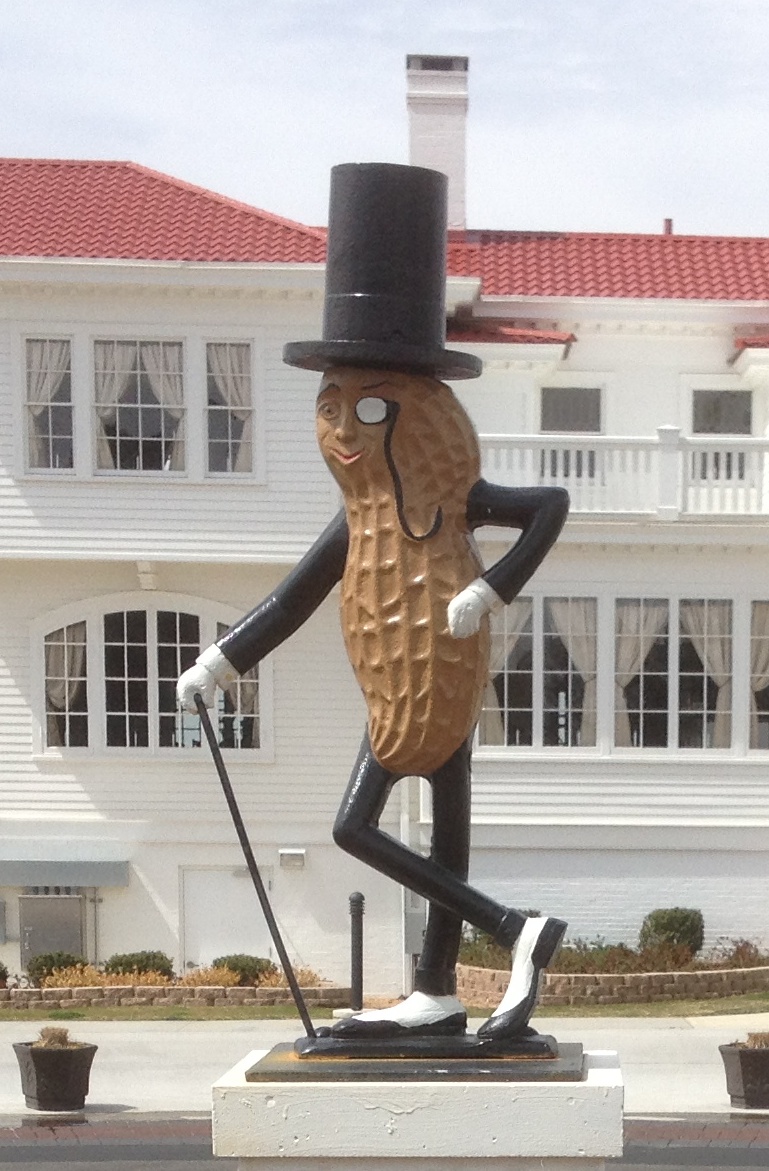
Mr. Peanut Shines in Suffolk!

Few things are more iconic of Suffolk than Mr. Peanut! 


The Planters Peanut Company first located in Suffolk in the early 20th century to be close to the fields of Southside Virginia that grew (arguably!), the world’s finest peanuts.  In 1924, the founder of the company, Amadeo Obici and his wife expanded an 1870’s farmhouse into an Italian Renaissance style home on the banks of the Nansemond River.  Easily recognizable due to its prominent and colorful hipped, terra cotta tile roof, the house was the Obici home until Amadeo’s death in 1947. 

The property was eventually re-developed into Sleepy Hole Golf Course with the Obici House serving as the clubhouse and a reception center for the community.  By the early 21st century however, the house was abandoned and rapidly deteriorating.  An ad hoc group formed as Citizens for the Preservation of the Obici House and refused to allow the house to be demolished.  Through persistent advocacy, they urged the City of Suffolk, by then the owner of the property, to preserve the house and its ties to the history of Suffolk. 


In 2009, Preservation Virginia added The Obici House to its list of Endangered Sites. Because of the strength and determination of the local group, we chose The Obici House as one of the sites for our public announcement of the list. Using the publicity our designation helped generate along with their own efforts, the Citizens group was successful in having the City send out a request for rehabilitation proposals.  Ultimately, the operator of the golf course undertook the work.


We are pleased to see, and as this prototroph taken last week demonstrates, that the Obici House is once again a centerpiece property.  While some early if not original elements were lost or replaced, the house is saved and the legacy of Amadeo Obici and Mr. Peanut are preserved in Suffolk.  Now everyone attending a function, or simply enjoying an afternoon of golf, can see the splendor that was, and is again, this fine house. 


The Citizens can take great satisfaction in the success of their efforts. Suffolk proudly proclaims on a welcoming plaque the City's role in the saving of the house.  A good preservation success can reward many efforts.  Preservation Virginia congratulates all who had a role in the saving of this important place. 


And, Hey! – next time you are in the Suffolk area come by and enjoy some peanuts, a nice round of golf and a beautifully preserved Obici House!

Thursday, April 11, 2013

Previous Endangered Sites- Booker T. Washington National Memorial


Preservation Virginia is grateful to Carla Whitfield, Superintendent of the Booker T. Washington National Monument in Franklin County, for writing the following blog post. The Booker T. Washington National Monument was listed on Preservation Virginia’s Most Endangered Sites List in 2006 due to a proposed residential and commercial development that would occur on land adjacent to the park.  For more information about the Booker T. Washington National Monument please see this link.
 
****
 
 
Booker T. Washington National Monument/ Preservation VA Endangered Sites List

The nationally significant Booker T. Washington National Monument (BTWNM) was established on April 2, 1956 on the occasion of the 100th birthday of the renowned educator.  The Monument was administratively added to the National Register of Historic Places on October 15, 1966. The Monument comprises 239 acres located in the Westlake vicinity (Gills Creek District) of Franklin County and is administered by the National Park Service (NPS). 

The Monument contains a visitor center, administrative offices and maintenance support and storage headquartered within the former Booker T. Washington Elementary School building, (a segregated school for African American children from 1954 – 1966). Cultural resources include a 1890s tobacco barn, marked archeological sites and historic features, cemeteries, the Plantation Trail which allows visitor access to the park’s Historic Area, and the Jack-O-Lantern Branch Trail which loops through old field meadows and forests and introduces visitors to the rich diversity of natural resources located within the park. Twentieth-century replicas include the kitchen cabin, smoke house, horse barn, corn crib, blacksmith shop, hog pen, split rail fences, duck lot, and chicken house. While most farmscape structures are conjectural, the kitchen cabin location is accurately based on a 1959 archeology study.
 
 
The plantation house, known as the “big house” during Washington’s tenure on the farm, burned in 1950. Its location is currently identified by an outline of stones that illustrate the dimension and size of the house. A second slave cabin structure believed to be the location of Washington’s birth, once existed to the east and behind the plantation house and is marked with a similar outline of stones. Both former structures have been located and identified through a 1999 Archeology Assessment. Heritage breed farm animals are kept at the park. Heirloom vegetables, dark-fired tobacco, corn, flax, and other 19th-century era demonstration crops are cultivated and harvested for interpretive setting and visitor education.

Mission
Booker T. Washington National Monument preserves and protects the birth, childhood home, and emancipation site of Booker T. Washington while interpreting his life experiences and significance in American history as the most influential African American between 1895 and 1915. The park provides a resource for public education and a focal point for continuing discussions about the legacy of Booker T. Washington, slavery, and the evolving context of race in American society.


Management  
Booker T. Washington National Monument is managed as an engaging educational center where Washington’s life and work and the complexity of American civil rights and race relations from the antebellum period to the present can be examined. This concept expands the mission of the site beyond its original legislative purpose as a memorial to Mr. Washington, noted “educator and apostle of good will.”  The goal is to create a dynamic, challenging environment in which visitors contribute their views on the issues presented through on-site interpretation of life on a small, slave-holding Virginia tobacco plantation. Living history presentations of life during Washington’s developmental years as an enslaved child, supplemented by ranger programs, special events, an orientation film, and interactive exhibits, provide visitors with a sensory immersion experience that lends understanding of the meaning and significance of Washington’s life and the Monument. 

Resources are managed in a way to visually tell a compelling story. Existing historic and reconstructed structures, including buildings and fences, remain in situ to be preserved through regular maintenance. Some reconstruction of cultural landscape features may be undertaken from time to time if sufficient documentation is found. Natural resources have been baseline inventoried and are continuously monitored by park staff with assistance from the NPS Mid - Atlantic Inventory & Monitoring Program. The park is supported by a large and enthusiastic Volunteers-In-Parks Program and advocated for by the Friends of Booker T. Washington National Monument.

 Benefits of National Monument Designation
   A source of pride and identity and a benefit to the Franklin County community. The uniqueness of having a site that has been designated as being significant by the people of the United States of America, to be preserved and protected because of its importance and relevance to the American Experience.

   Raises profile of the site and brings new visitors.  Hotels, restaurants, tour guide agencies and local businesses all reap the economic advantages of national monument designation.

   Provides a unique opportunity to stimulate rural economies.  According to the NPS, every dollar invested in national parks generates $10 in return to local communities.   

   National monuments protect America’s most treasured lands, helping to guarantee they remain intact and unadulterated, while ensuring a lasting legacy for future generations.

Planning Concerns

   In order to achieve its mission, the BTWNM must ensure that stream flows, both quantity and quality, are sustained in healthy condition.  Therefore, the success of the Monument is dependent on all actions within the watershed that affect flows in Gills Creek and Jack-O-Lantern Branch streams.

   Visitors to BTWNM bring with them the expectation of an experience that portrays the mid-nineteenth century environment into which Mr. Washington was born and spent his early childhood years in slavery. An integral component of that experience is the visual experience.  In order to deliver the opportunity for such visitor experience, it is important that uses outside the Monument but visible from within the historical core be designed with sensitivity to the Monument mission. The viewshed from within the park must be considered to protect the historical integrity of the site and quality of the visitor experience.

Planning and Development Context
For most of the Monument’s existence, the land surrounding the park has remained rural and in agricultural use with very little development. The park was able to purchase an adjoining 15 acres along VA Route 122 road frontage and along the park’s east border in 2003 to serve as a buffer for town center development that was beginning approximately 1/8 mile from the park border.

During the summer of 2005, Franklin County rezoned the land immediately east of the monument from Agriculture to Planned Commercial Development. A 57 acre parcel abutting the east boundary of the monument is proposed for high density development. Although the downturn in the economy has slowed development, a sewage pumping station has been installed along with line that runs the entire length of the park’s eastern boundary to a developed leach field just north of park property for future development needs. A new beer brewery is also near completion on the adjacent property and electric transmission infrastructure has been installed. Development of the entire parcel will schedule as the economy and development stabilizes in the Westlake town center area.

The original development of Westlake that started in early 2000 has expanded to include many independent-living community homes, a medical center, and an emergency response helipad which maintains an emergency evacuation helicopter that flies response flights over the perimeter of the park several times a day.

At the northwest corner of the park boundary, in 2010, a two acre parcel was clear cut of trees and since has been established as a two-trailer rental property. The park currently shares an entrance to its headquarters with residents who rent the trailers and the property owner who maintains the property. The trailers have impacted the viewshed from within the park and the formality of the park’s main entrance. The trailers are in clear view of visitors as they approach and enter the park main entrance from either direction on VA Route 122.

A large tract of farmland along the park’s south border that has been in agricultural and forest use for generations was surveyed in 2012 and the current landowner is in negotiation with developers. The outcome of the future use of the property is unknown by the park at this time but changes to its current land use could dramatically impact viewshed and visitor experience since the park’s scenic Jack-O-Lantern Branch Trail is located along the length of the same boundary. The Jack-O-Lantern Branch stream is the dividing boundary between the park and property and any future development that would take place if the land is sold and developed would impact the ecosystem health of the stream and its aesthetic contribution to the visitor experience.

Booker T. Washington National Monument is working with community members, its Friends Group, and County planners to create awareness and hopefully mitigate impacts to park resources as a result of changes in surrounding land use. This cooperation will encourage developers and land users within the viewshed of the BTWNM to consider, at the design stage, how their potential development and uses might affect the Monument mission.

Purchase of adjoining land by the National Park Service or implementing landowner conservation easements to preserve the surrounding agricultural setting is still a park-preferred alternative.  
 
--Carla Whitfield


Monday, April 8, 2013

What is Happening with Belmead on the James?

Powhatan County may seem out of the way, but it won’t for long once you visit Belmead on the James.  Almost two centuries of history unfolds at Belmead and mirrors the struggles and triumphs of African Americans in Virginia.  Designed by Alexander Jackson Davis and built by the plantation’s enslaved workers, Belmead might have been counted as simply another plantation-- a page in the history books.  Instead in 1893 the property was purchased by Colonel and Mrs. Edward de Vaux Morrell of Philadelphia and donated to Katharine Drexel and the Sisters of the Blessed Sacrament.  For her work here and nationwide, Katherine Drexel was canonized as saint in 2000.  In her life, she provided a vision to educate Native American and African American students in schools across the country.  At Belmead, St. Francis and St. Emma were built and for seven decades tens of thousands of young African American boarding students studied academic lessons, learned skills, and lived a sustainable existence.  Accredited by the Commonwealth of Virginia in 1925, the school anchored the activities that made this property perk until its closing in the 1970s.  More than simply existing, Belmead instilled in its students and teachers a belief in the possibilities of confronting social injustice and providing a future for its African American students through education and training.

Time moved on.  Integration of local schools allowed children to live in their local communities rather than board at Belmead.  The Sisters of the Blessed Sacrament searched for ways to maintain their ministry while honoring their dedication to this land.  Preservation Virginia named the Granary at Belmead to Virginia Most Endangered Historic Sites in 2006.  With that recognition, Sisters of the Blessed Sacrament were able to find support to stabilize the structure.  In 2007 and again in May 2010, the entire campus of St. Francis De Sales School was named to the List after a major portion of the four story bell tower collapsed the previous March.  In 2011, with the support of alumni, friends and Preservation Virginia, Belmead was listed on National Trust’s Most Endangered Historic Places to raise awareness and to promote solutions related to the preservation of this significant property.
Belmead survived in part because of its nimbleness and its ability to plug into the economic and cultural needs of the times.  Once again reinvention is a foot at Belmead-on the-James.  

Taking what others would see as major setbacks, the Sisters of the Blessed Sacraments are staging a comeback for Belmead and the associated buildings.  The Granary has been stabilized.  Damage to Belmead itself sustained in the earthquake in 2011 has been repaired stopping leaks that plagued the manor house and kept uses rare. 

 
What is emerging is a coordinated and organized effort to build a program at Belmead that will invite people in, build resources and have defined uses for the future of this amazing site. Want to learn more—read Bill Lohmann’s article in the Richmond times Dispatch (this article inspired our revisits to Endangered Site listings) http://www.timesdispatch.com/entertainment-life/preserving-the-history-of-a-life-changing-place-before-it/article_a20156ec-3bb8-51c0-b50e-a5fc26e76774.html .

Friday, April 5, 2013

Previous Endangered Sites- the Entire City of Danville


In 2007, Preservation Virginia’s Most Endangered List included a rare designation— the entire City of Danville —as a result of multiple pleas for assistance regarding saving historic structures within the City.  
Since its nomination to the list, Danville has made progress in its historic preservation efforts including the creation of the River District Plan, a plan to protect and enhance the historic character and facilitate business in downtown, as well as plans to enhance historic areas along Grove Street and in the Five Forks area.  


View of Danville and Dan River

Many see the successful renovation and reuse of the Ferrell Building on Main Street as the catalyst to renewed preservation efforts by the city.  The Ferrell Building, one of the oldest buildings on Main Street, was saved from demolition in 2010 when Rehab Builders acquired it, renovated it and converted it into apartments and commercial space. 

However; Danville is not without its shortcomings. One example is the Fearn Plantation site− an important, early archaeological site with intact foundations that is planned for demolition to make room for industrial development.


Chimney and foundations at the Fearn site
Another example is what locals are calling the “red dot” district− an area of the Tobacco Warehouse District where many small, vernacular “worker’s” houses have been marked for demolition with large red dots.  While it is evident that some of these houses are beyond repair, local preservationists have asked to be involved in the process so that pockets of houses can be saved to help protect the historic mill town character. 

Historic preservation efforts have definitely improved in Danville, but Danville still has a ways to go when it comes to being a notable steward and protector of its historic resources.